
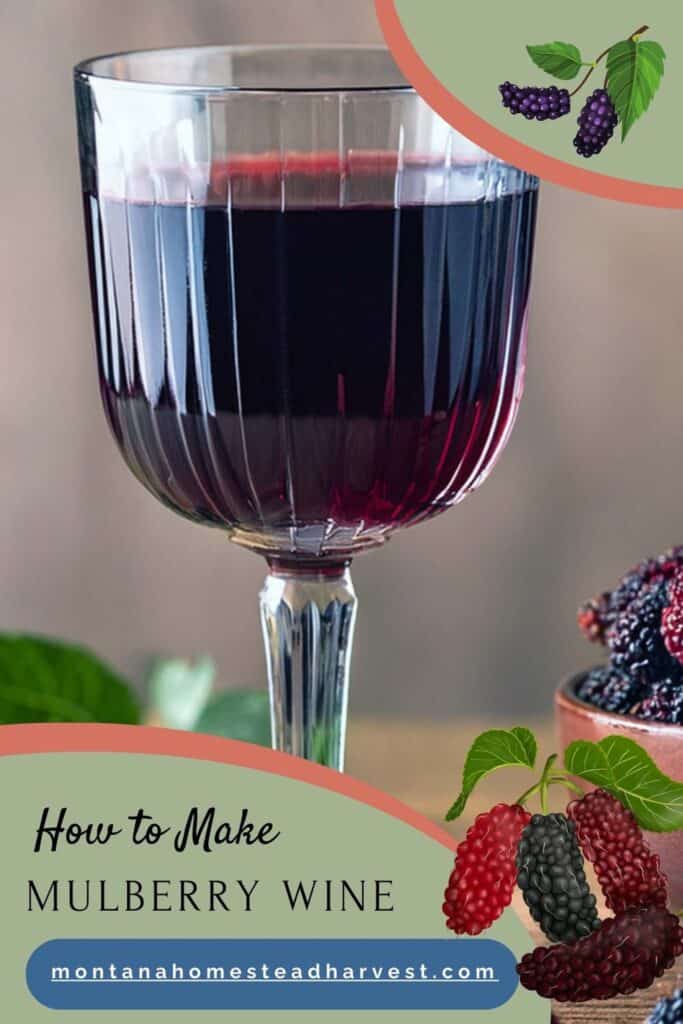
I've always loved mulberries and have imagined they would make a delicious wine. My instincts were right because this mulberry wine recipe might just be a new favorite! Mulberry wine has a beautiful, deep color, fruity notes, and a luscious flavor. It's also easy to make! Next, try my pear wine recipe!

Growing up in Chicago, we had a beautiful mulberry tree outside our house. It was more like the neighborhood mulberry tree because people felt free to climb the tree and pick its fruit.
I suppose they knew my mom was generous and did not mind sharing. These days, when I go back to Chicago, I always visit the old neighborhood and sneak a few mulberries for old time's sake!

So last spring, when my sister-in-law, Tami, gave me some frozen mulberries from the previous year's harvest, I knew exactly what I wanted to make with them... mulberry wine!
The wine turned out even better than I had imagined, and since it tasted so good at bottling, I can only imagine how much better it will be 6 months or a year from now.
Jump to:
Ingredients & Substitutions

- Mulberries: Fresh mulberries or frozen can be used to make mulberry wine. Freezing mulberries first helps them break down more easily, which allows them to release more juice.
- Sugar: White granulated sugar
- Acid: To add acidity, I used the juice of one lemon. You can substitute with 1 teaspoon acid blend.
- Yeast: I used Premiere Blanc, but feel free to use Cotes Des Blancs or Premiere Cuvee.
- Other Ingredients: Wine tannin (for added structure), pectic enzyme (to break down the fruit pulp), and yeast nutrient (to nourish the yeast).
See recipe card for quantities.
How to Make Mulberry Wine

- Place a mesh bag in the fermenter bucket and fill with mulberries, then tie. Add lemon juice and zest.

- Add water to a stock pot and stir in sugar over medium heat until dissolved and the water is hot. Remove from heat to cool.

- Pour cooled syrup over mylberries along with tannin and pectic enzyme. Mash berries with a potato masher.

- Activate the yeast in warm water, then pour it into the bucket with the yeast nutrient. Take SG reading. Mine was 10.90

- Stir daily to aerate. Take SG reading on day 5, then rack mulberry wine into a sterilized carboy.

- Clear wine for a few months, reracking each time into a clean carboy and leaving the sediment behind.

- Once your mulberry wine is completely cleared, take a final SG reading and use an ABV calculator to figure out the alcohol %. Transfer to sterilized wine bottles.

- Cork and label bottles with wine name, date, and alcohol percentage. Age from 6 months to a year, then enjoy!

Equipment
Bottles/Corks/Corker: Most people begin by bottling their wine in flip-top bottles. However, as they continue to make wine, they graduate to wine bottles, corks, and a corker.
Sanitizer: All of your equipment needs to be sanitized every time you make wine. You have various options, including a concentrated liquid sanitizer (Star San) or a powder that can be diluted in water (1-Step).
2 Gallon Plastic Fermenting Bucket: The primary fermentor is used for the first 5-7 days to get your fermentation/must going. Although it comes with a lid, I cover it with a breathable fabric and secure it with a rubber band. The fabric keeps out the bacteria while allowing some oxygen in to help the yeast get started.
Strainer/Mesh Bag: You can add your fruit to a mesh bag while it's fermenting or dump everything inside the primary fermentor bucket. If you decide to use the bag, you'll squeeze the bag to extract the fruit juice and toss the solids that remain in the bag. If you add the fruit directly inside the primary fermentor, you will need to strain the contents of the bucket before transferring them to a carboy.
1 Gallon Jug: You will need a one-gallon carboy, also called a demijohn, which is used for fermenting and clearing the wine. Having at least 2 is ideal, especially when racking or transferring the wine from one carboy to another for clearing.
Mini Auto-Siphon & Tubing: The siphon and tubing are used when transferring the wine from one carboy to the next and also for bottling the wine. A bottling wand also comes in very handy, but is not required.
Air Lock and Bung: The airlock goes into the bung, and the two together are used to cap the carboy when it is fermenting and clearing. The airlock keeps oxygen and bacteria from contaminating the wine while allowing the CO2 to escape.
Hydrometer & Test Jar: A hydrometer is used to figure out the amount of alcohol your finished wine contains. This is done by taking readings of the specific gravity or SG at the beginning, during, and at the end of the fermentation process.
Funnel: You'll need a funnel for straining the fruit, especially if you don't use a mesh bag. I like this funnel.
Jug: A small creamer like this one comes in handy when taking SG readings.

This wine-making kit is the one I recommend because it has almost everything you need!
FAQ
Ripe, dark-purple mulberries are recommended for the richest flavor. Using frozen mulberries is also an option, which is a great way to use the seasonal harvest
For beginners, a standard red wine yeast like Red Star Premier Classique or a versatile Lalvin yeast is an excellent choice. For more control over flavor, experiment with yeasts known to produce fruity or spicy notes.
Not every stem has to be removed; however, removing as many stems as possible is best. They can impart an unpleasant flavor to the finished mulberry wine.
Pro Tips
- The longer you let the mulberry wine clear, the better the results will be!
- Don't toss out the lees (dead yeast that collects on the bottom of the carboy and fermenting bucket). Add it to your compost bin instead!
- If you don't have enough mulberry wine to fill all 5 bottles, flip-top bottles can be used for the rest.
More Fermenting Recipes
If you enjoy this mulberry wine recipe, be sure to try these other fermenting recipes too!


Recipe

Homemade Mulberry Wine
Equipment
Ingredients
- 3 lbs mulberries
- 1 gallon water
- granulated sugar
- 1 medium lemon
- tannin
- pectic enzyme
- 1 packet Premiere Blanc yeast
- yeast nutrient
Instructions
- Place mesh bag in a fermenter bucket, then fill with mulberries and tie. Add lemon juice and zest.
- Add water to a stock pot and stir in sugar over medium heat until dissolved and the water is hot. Remove from heat to cool.
- Pour cooled syrup over mylberries along with tannin, and pectic enzyme. Mash berries with a potato masher.
- Activate the yeast in warm water, then pour it into the bucket with the yeast nutrient. Take SG reading. Mine was 10.90.
- Stir daily to aerate. Take SG reading on day 5, then rack in a sterilized carboy.
- Clear wine for a few months, reracking each time into a clean carboy and leaving the sediment behind.
- Once completely cleared, take the final SG reading and use an ABV calculator to figure out the alcohol content. Transfer to sterilized wine bottles.
- Cork and label bottles with wine name, date, and alcohol percentage. Age from 6 months to a year, then enjoy!
Notes
- The longer you let the wine clear, the better the results will be!
- Don't toss out the lees (dead yeast that collects on the bottom of the carboy and fermenting bucket). Add it to your compost bin instead!
- If you don't have enough wine to fill all 5 bottles, flip-top bottles can be used for the rest.
Hilda Sterner says
I hope you give this mulberry wine recipe a try!
Teresa Robbins says
This was excellent wine! Smooth and tastey, can’t wait for my next glass!
Hilda Sterner says
I'll drink to that, cheers! 🍷